When Trust Feels Impossible: What Therapy Can Actually Do
Therapy for trust issues is one of the most effective ways to break free from the intense pain caused by betrayal, as well as the cycle of fear, suspicion, and emotional distance that keeps you from fully connecting with others.
If you’re looking for a quick overview of your options, here’s what you need to know:
Best therapy approaches for trust issues:
- Gottman Method – Identifies the four leading predictors of divorce, and provides skills to overcome each one.
- Cognitive Behavioral Therapy (CBT) – Identifies and rewrites distorted thought patterns driving mistrust
- Emotionally Focused Therapy (EFT) – Repairs attachment bonds and builds emotional safety
- EMDR – Processes trauma memories that keep the nervous system stuck in hypervigilance
- Schema Therapy – Addresses deep-rooted beliefs formed in childhood
- Mindfulness-based approaches – Helps you observe mistrustful thoughts without reacting to them
What to expect:
- Initial relief begins for some folks simply by making their first appointment
- Early relief can come within the first few weeks because the process has started, and folks often feel heard in new ways
- Meaningful relationship improvement typically appears around the 3-6 month mark
- Deeper healing from significant betrayal or trauma can take 6 months to 2 years
Trust issues aren’t a personal failing. They’re often the nervous system’s way of protecting you after being hurt — by a partner, a caregiver, or someone you depended on. That protection made sense once. But over time, it can quietly close the door on intimacy, honesty, and real connection.
Whether you’re navigating the aftermath of infidelity, carrying wounds from childhood, or simply noticing a pattern of pulling away when relationships deepen — therapy offers a structured, evidence-based path forward.
I’m Dr. Neil Cannon, an AASECT Certified Sex Therapist and Licensed Marriage and Family Therapist with decades of experience helping individuals and couples find their way back to trust and connection through therapy for trust issues. I’ve worked with clients across the full spectrum of relational challenges — from early attachment wounds to affair recovery — and I know that real, lasting change is possible.
Therapy for trust issues vocabulary:
- hope after cheating/infidelity
- Punch the Monkey shows us the value of relationships
- Sexual health education
Understanding Trust Issues and Their Root Causes

When we talk about trust issues, we are really talking about a persistent fear or reluctance to open up to others. It is the feeling that at any moment, the rug could be pulled out from under you. While it might feel like a personality trait, it is actually a learned survival mechanism.
Our research and clinical experience show that trust issues are rarely about the present moment alone. Instead, they are often rooted in our attachment styles—the blueprints for relationships we developed in infancy.
- Anxious Attachment: If your early caregivers were inconsistent, you might grow up feeling like you have to “chase” trust, leading to jealousy or a constant need for reassurance.
- Avoidant Attachment: If your needs were dismissed, you might learn that people are unreliable, leading you to keep everyone at arm’s length to avoid being let down.
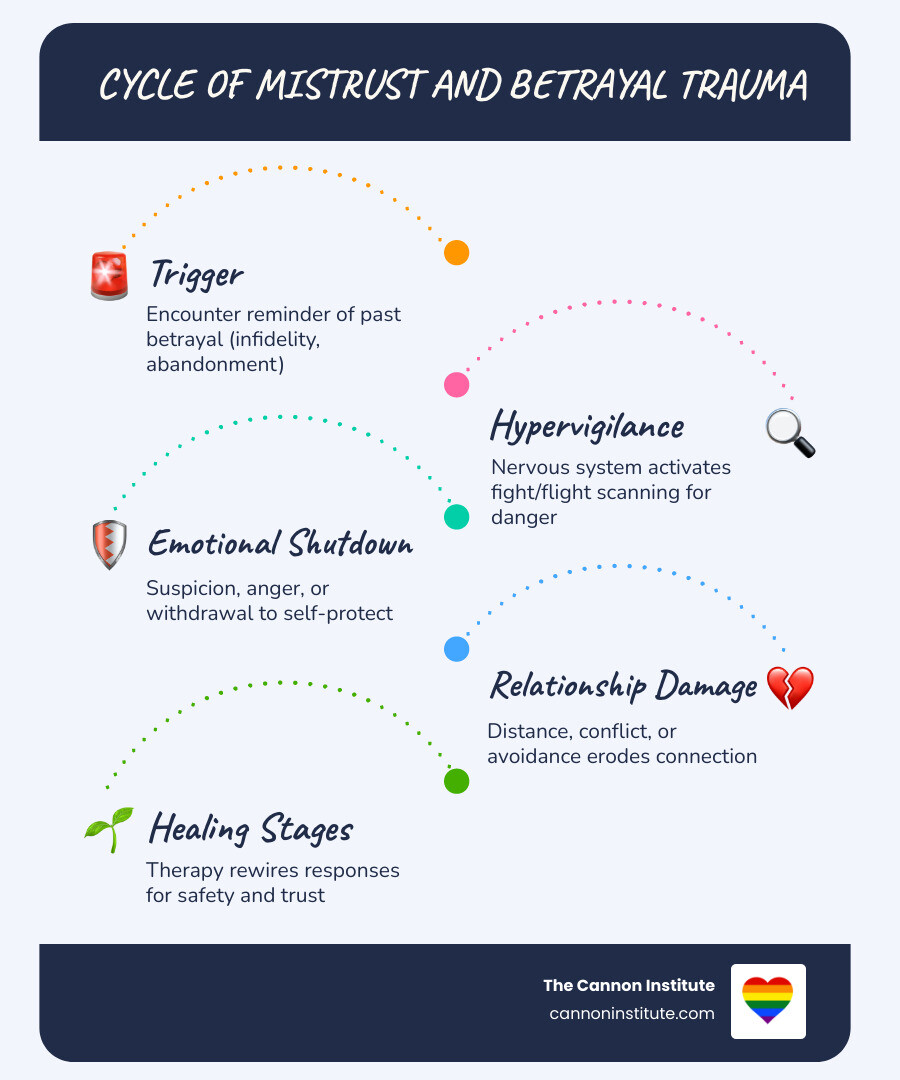
Beyond childhood, Adultery Infidelity is one of the most common catalysts for adult trust struggles. When a partner breaks a fundamental agreement, it creates betrayal trauma. This isn’t just a hurt feeling; it is a psychological injury that can cause symptoms similar to PTSD, such as hypervigilance (scanning for signs of lies) and emotional distancing (numbing yourself so you don’t get hurt again).
According to Trust Issues and Therapy, these issues can also stem from low self-esteem or underlying mental health conditions like generalized anxiety or personality disorders. Essentially, your brain has decided that the world is unsafe, and it is doing its best to protect you by staying on high alert.
Signs of Trust Issues in Relationships
How do you know if you’ve crossed the line from healthy caution to problematic mistrust? Here are the common signs we see in our Denver office:
- Snooping Behaviors: Feeling a compulsive need to check a partner’s phone, emails, or bank statements, even when there is no evidence of wrongdoing.
- Constant Reassurance: Asking “Do you really love me?” or “Are you sure you aren’t mad?” dozens of times a day because you can’t believe the initial answer.
- Commitment Phobia: Pulling away just as a relationship starts to get serious or “testing” a partner to see if they will leave.
- Professional Self-Sabotage: In a work setting, this looks like an inability to delegate because you assume others will fail you, or catastrophic thinking about your boss’s intentions.
- Social Isolation: Assuming friends have hidden motives, leading you to stop sharing your true self with others.
Evidence-Based Therapy for Trust Issues

The good news is that the brain is plastic. Through therapy for trust issues, we can actually rewire the nervous system to move from a state of “protection” to a state of “connection.”
One of the most critical factors in this journey is the therapeutic alliance. For someone with trust issues, the relationship with the therapist serves as a “laboratory.” It is a safe space where you can practice being vulnerable with someone who is consistently reliable and empathetic.
We use somatic tracking to help you notice how mistrust feels in your body. Does your chest tighten? Does your breath get shallow? By regulating the nervous system first, we make it possible for the logical part of your brain to take back control from the “fight-or-flight” center. This trauma-informed care ensures that we aren’t just talking about the problem, but actually healing it at a cellular level.
Cognitive Behavioral Therapy for Trust Issues
CBT is often considered the “gold standard” for addressing the thoughts that fuel mistrust. We use cognitive restructuring to help you identify “distorted beliefs.”
For example, if a partner is ten minutes late, your brain might jump to: “They are with someone else.” In therapy for trust issues, we teach you to pause and look for evidence. We might run behavioral experiments, like intentionally not checking a phone for an afternoon and observing that the world didn’t end. This helps shift your core beliefs from “people are dangerous” to “I can handle uncertainty.”
Emotionally Focused Therapy for Trust Issues
While CBT handles the thoughts, EFT handles the heart. Developed by Dr. Sue Johnson, EFT focuses on attachment repair. We look at the “dance” you and your partner do. Perhaps one of you “pursues” with questions while the other “withdraws” to stay safe.
Through Relationship Therapy, we help you reach for emotional attunement. You learn to express the underlying fear (“I’m afraid I don’t matter to you”) rather than the surface-level accusation (“Why were you late?”). These corrective emotional experiences create a new foundation of safety.
Specialized Modalities for Deep Healing
For those dealing with deep-seated childhood trauma or severe betrayal, we may use more specialized tools:
- EMDR (Eye Movement Desensitization and Reprocessing): This helps take the “sting” out of traumatic memories so they no longer trigger a full-body panic response in the present.
- Schema Therapy: We identify “mistrust/abuse” schemas formed early in life. Using imagery re-scripting and limited reparenting, the therapist helps provide the emotional validation you missed as a child.
- Mindfulness-Based Stress Reduction: This teaches you to witness your suspicious thoughts like clouds passing in the sky, rather than accepting them as absolute truth.
Individual vs. Couples Therapy for Rebuilding Trust
Deciding which path to take depends on where the trust was broken.
| Feature | Individual Therapy | Couples Therapy |
|---|---|---|
| Primary Focus | Building self-trust and healing personal history. | Repairing the bond between two people. |
| Best For | Past trauma, childhood wounds, or if a partner won’t join. | Infidelity recovery, communication breakdowns. |
| Key Goal | Setting personal boundaries and self-regulation. | Establishing transparency and mutual accountability. |
In Individual Therapy, the work is about you. We help you define your own personal boundaries and learn to trust your own intuition again. Many people with trust issues actually struggle with self-trust—they don’t trust their ability to pick healthy partners or survive a disappointment.
In Affair Recovery Counseling, the focus shifts to the “us.” This requires transparency protocols, where the partner who broke trust agrees to radical honesty to help the other’s nervous system calm down. It isn’t about “policing” the other person; it’s about providing the “scaffolding” of safety while the relationship heals.
The Timeline for Rebuilding Trust
One of the most common questions we hear in our Denver practice is: “How long will this take?”
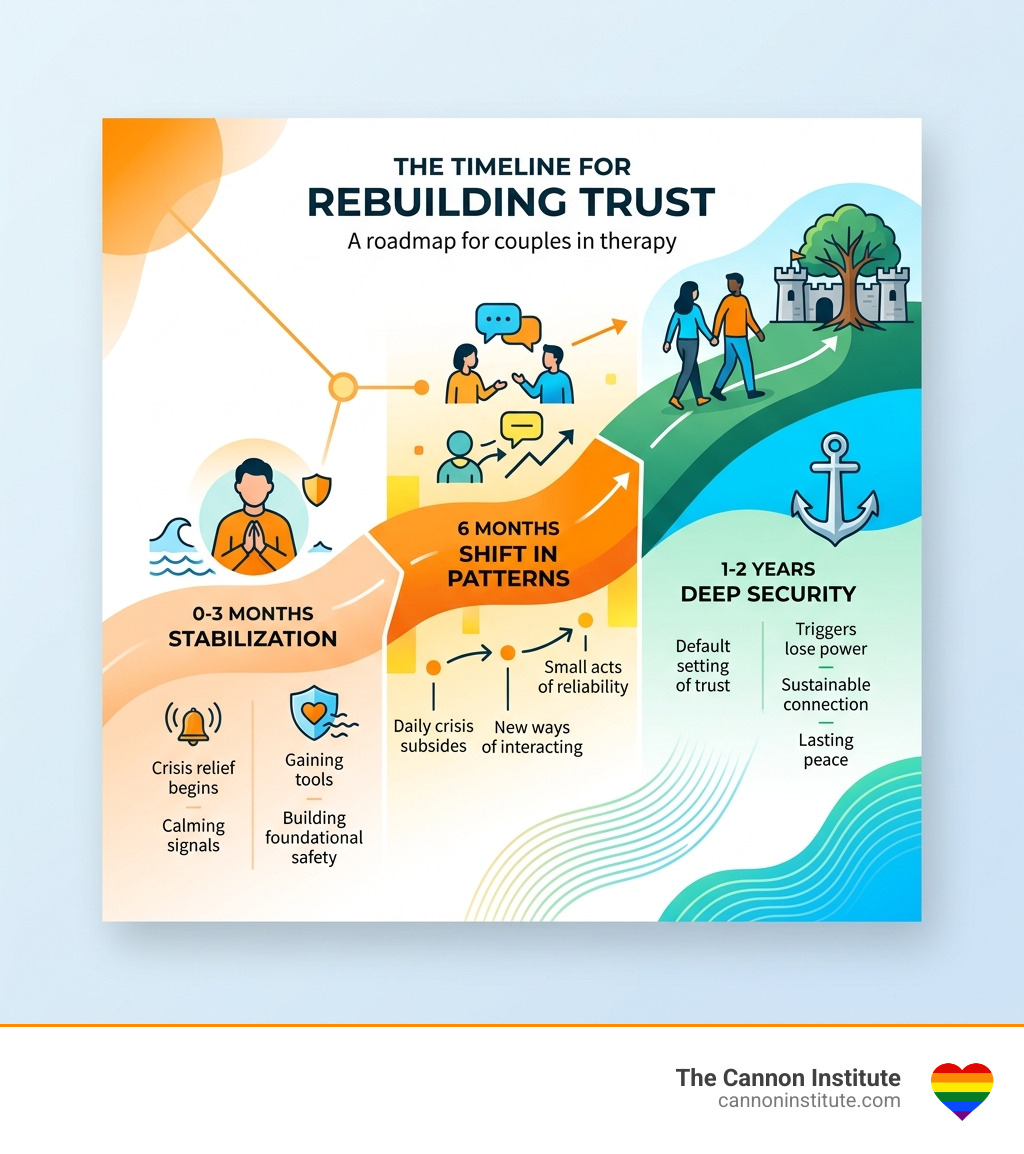
While every situation is unique, research gives us a general roadmap. Most couples who engage consistently in therapy for trust issues see a 3-6 month milestone where the daily “crisis” feeling begins to subside. You stop feeling like you’re walking on eggshells every second.
However, deeper work—the kind that makes trust feel like a “default” setting again—typically takes 6 months to 2 years. As we discuss in Everything You Need To Know About Hope After Cheating, consistency is more important than intensity. It’s the small, daily acts of reliability that rebuild the wall of trust, one brick at a time.
Frequently Asked Questions about Therapy for Trust Issues
How long does it typically take to rebuild trust through therapy?
As mentioned, you can expect to feel some “crisis relief” within the first few weeks as you gain tools to manage anxiety. Significant shifts in how you interact usually happen around the 6-month mark. For deep trauma, plan for 1 to 2 years of consistent effort to ensure the changes are sustainable and the “old” triggers no longer have power over you.
Can therapy help if my partner refuses to attend?
Absolutely. You are 50% of the relationship dynamic. When you go to Individual Therapy, you learn how to set boundaries and regulate your own emotions. Often, when one partner stops “dancing” the old way—for example, by stopping the cycle of interrogation and instead focusing on their own peace—the other partner is forced to change their response as well.
What are the signs that therapy for trust issues is actually working?
You’ll know it’s working when you notice:
- Reduced Hypervigilance: You don’t feel the “itch” to check their phone as often.
- Improved Conflict Repair: When you do have a fight, you can come back together and talk about it calmly within hours, rather than days.
- Flexible Discernment: You stop seeing things in “black and white” (trust vs. betrayal) and start seeing the nuances of human behavior.
- Increased Emotional Safety: You feel a “warmth” in your chest when thinking about your partner, rather than a “tightness.”
Conclusion
Trust is the oxygen of a relationship. When it’s gone, it feels like you’re suffocating. But at The Cannon Institute in Cherry Creek, we have seen even the most “broken” relationships find their way back to a place of deep, secure connection.
Led by Dr. Neil Cannon, our team provides research-based, intentional interventions designed for the modern individual and couple. We don’t just offer a place to vent; we offer a roadmap for sustainable change. Whether you are navigating the pain of an affair or the echoes of childhood neglect, there is hope.
If you are ready to stop living in a state of suspicion and start building a life of intimacy and peace, we are here to help. Start your healing journey with specialized Relationship Therapy today. You don’t have to carry the weight of mistrust alone anymore.