Why Solution Focused Therapy Offers a Fresh Path Forward
Solution focused therapy is a brief, goal-oriented therapeutic approach that shifts the conversation from what’s wrong to what’s possible. Instead of diving deep into past problems, it helps you identify your strengths, envision your preferred future, and take practical steps to get there.
Key Features of Solution Focused Therapy:
- Future-Focused – Emphasizes what you want to achieve rather than dwelling on past difficulties.
- Brief by Design – Typically 3-8 sessions, making it efficient and cost-effective.
- Strengths-Based – Builds on what’s already working in your life.
- Client-Directed – You define the goals and solutions that matter most to you.
- Collaborative – The therapist acts as a guide, not an expert who diagnoses your problems.
If you’ve felt stuck analyzing why you have problems without finding clear paths forward, solution focused therapy offers a refreshing alternative. It assumes you already possess the resources needed for change.
The core difference is simple: traditional therapy often asks, “What’s wrong and why?” Solution focused therapy asks, “What do you want instead, and what’s already working?”
This matters especially when you’re facing intimate, sexual, or relationship challenges. These struggles can feel overwhelming. Solution focused therapy respects your pain while directing energy toward building the connection, intimacy, and satisfaction you desire.
Research backs this up. Numerous randomized controlled trials and meta-analyses confirm its effectiveness for depression, anxiety, relationship issues, and more – often as effectively as longer-term approaches but in fewer sessions.
I’m Dr. Neil Cannon and an AASECT Certified Sex Therapist and Licensed Marriage & Family Therapist with two decades of experience, I’ve found solution-focused therapy fits sex, intimacy, and relationship work because it honors client expertise and builds clear, practical pathways to deeper connection!
Understanding the SFBT Framework: A Shift from Problems to Possibilities
Think about navigating a new city. You could analyze every past wrong turn, or you could plot a course to where you want to go. Solution focused therapy chooses the second path.
This practical approach was developed in the 1970s and 80s by Steve de Shazer and Insoo Kim Berg. They observed therapy sessions to see what actually helped people move forward, rather than theorizing about what should work. They finded that focusing on what clients want to achieve was more effective than digging into the history of their problems.
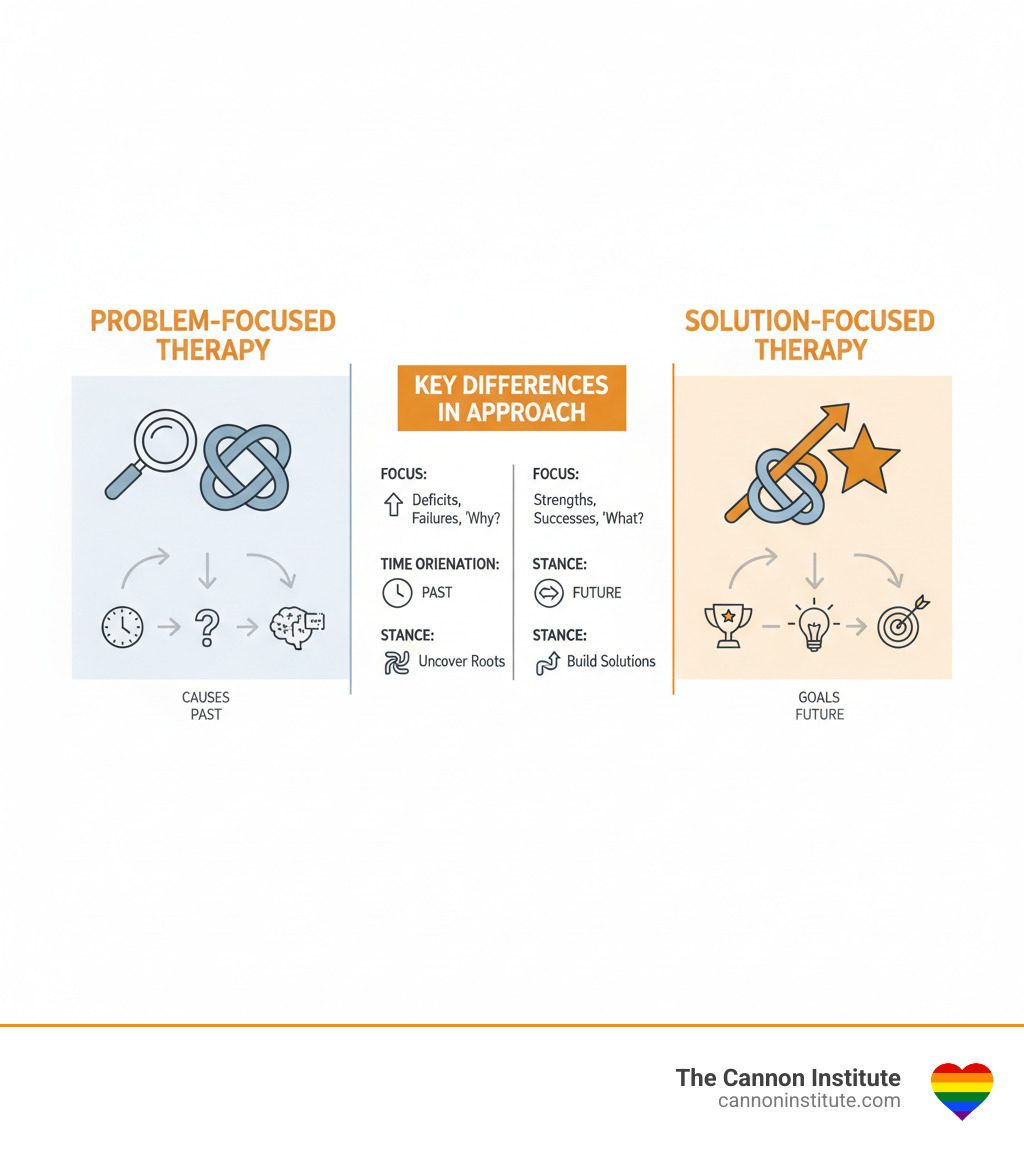
Here’s how solution focused therapy stands apart from traditional approaches:
| Feature | SFBT | Traditional Problem-Focused Therapies |
|---|---|---|
| Focus | Solutions, strengths, resources, future | Problems, pathology, past causes, deficits |
| Therapist Role | Collaborator, guide, “not-knowing” stance, elicits client’s wisdom | Expert, diagnostician, interpreter, identifies root causes |
| View of Change | Change is constant, small changes lead to big ones, client-driven | Change requires insight into past, often therapist-driven |
| Duration | Brief (typically 3-8 sessions) | Longer-term (often months or years) |
What is Solution-Focused Brief Therapy (SFBT)?
Solution-Focused Brief Therapy (SFBT) is a therapeutic approach that helps you identify your strengths and build the future you want. It is:
- Future-oriented: We talk about what you want your life to look like, not why you have problems.
- Goal-directed: We define clear, achievable goals that reflect your best hopes.
- Focused on what works: We look for times when the problem is less severe and figure out how to create more of those moments.
- Client-as-expert: You know your life best. Our job is to help you recognize and use the wisdom, strengths, and resources you already have.
Core Principles of Solution Focused Therapy
The principles behind SFBT are simple and powerful:
- Change is constant: We harness life’s natural momentum.
- Small changes lead to big changes: The first domino can create significant shifts.
- The client has resources: We seek out your existing skills, past successes, and resilience.
- Future focus is key: Conversations are steered toward your desired outcomes.
- Simplicity works: Solutions don’t need to be complicated. We follow three guidelines: if it isn’t broken, don’t fix it; if it works, do more of it; if it isn’t working, try something different.
How SFBT Differs from Other Therapies
Unlike Cognitive Behavioral Therapy (CBT), which often changes negative thought patterns, SFBT skips straight to, “What would you prefer to be doing, and how can we get there?”
The contrast with psychodynamic therapy is even sharper. Psychodynamic work explores the past to understand current problems. SFBT deliberately stays focused on the present and future, operating on the principle that understanding a problem’s origin isn’t always necessary to solve it.
This focus on “how” not “why” means less emphasis on diagnosis and more on building your unique path forward. It shares common ground with positive psychology, which also emphasizes strengths and empowers people to achieve well-being.
The Toolkit of Solution Focused Therapy
Solution focused therapy uses specific conversational techniques to help you build your own solutions. These tools harness the power of language to open up new possibilities.
The Miracle Question: Envisioning a Better Future
The Miracle Question is a well-known SFBT tool that shifts focus from problems to a clear vision of what you want. It sounds like this:
“Suppose tonight, while you’re sleeping, a miracle happens and the problem that brought you here is solved. Since you were asleep, you don’t know it happened. When you wake up, what’s the first small thing you’d notice that would tell you something is different?”
This question helps you describe your preferred future in concrete terms. It bypasses problem talk, helps define clear goals, and creates a tangible vision to work toward. This shift from despair to hope is especially powerful when dealing with overwhelming intimate or relationship challenges.
Scaling and Coping Questions
Scaling questions make progress measurable. We might ask: “On a scale of 0 to 10, where 10 is the problem solved and 0 is the absolute worst, where are you right now?” This helps identify small improvements and track progress. Exploring what it takes to move from a 3 to a 4 makes change feel achievable.
Coping questions highlight your existing resilience. A therapist might ask, “Given everything you’ve been facing, how have you managed to keep going?” or “What have you done to prevent things from getting even worse?” These questions invite you to recognize the strength you’re already using, which can be transformative when you feel like you’re failing.
Finding and Utilizing ‘Exceptions’
“Exceptions” are moments when the problem isn’t happening or is less severe. These moments are gold because they show what’s already working. Identifying what was different during these times provides a blueprint for creating more of them. It’s about building on existing successes rather than inventing solutions from scratch.
Here are some questions we might explore to find these valuable exceptions:
- “Are there times when this problem is less severe or not happening at all?”
- “What’s different about those times?”
- “What did you do that was helpful?”
- “When was the last time you had even a small success with this?”
- “How did you make that happen?”
By focusing on exceptions, we recognize that you are not powerless. Our job is to help you notice these successes, understand them, and do more of what works.
The SFBT Process and Its Proven Effectiveness
The beauty of solution focused therapy is its efficiency. It’s designed to create meaningful change quickly, typically in just three to eight sessions.
A typical session begins by asking, “What’s been better?” to focus on positive shifts. We then explore your “best hopes” for therapy to ensure the work is directed by what matters most to you. The process is collaborative, with the therapist acting as a guide who trusts your expertise about your own life. We work together to access your wisdom and highlight your strengths.
What are the Goals and Outcomes of SFBT?
The goals of SFBT go beyond reducing symptoms; they center on empowering you to build the life you want. Key outcomes include:
- Client-defined goals: We collaboratively articulate clear, specific goals that reflect your genuine hopes.
- Increased hope: Focusing on possibilities fosters a belief that positive change is within reach.
- Empowerment: The process validates your capacity for change, reinforcing your ability to shape your life.
- Improved coping skills: You’ll recognize and strengthen the resourcefulness you already possess.
- Behavioral change: We identify small, actionable steps that build momentum over time.
- Improved self-efficacy: Your belief in your ability to achieve goals grows as you experience success.
Who Can Benefit from SFBT?
SFBT’s flexibility makes it effective for a wide range of people and situations:
- Individuals find it practical for depression, anxiety, stress, and life transitions.
- Couples benefit from its focus on creating the relationship they both desire, rather than assigning blame. At The Cannon Institute, we integrate these principles into our relationship therapy.
- Families learn to focus on shared goals instead of getting mired in conflict.
- Children and adolescents respond well to its positive, goal-oriented nature for issues like anxiety and behavioral problems.
The approach has also been successfully applied in schools, medical settings, and for issues like substance abuse and trauma.
The Evidence Base for Solution Focused Therapy
The effectiveness of solution focused therapy is backed by substantial research. Nearly 150 randomized clinical control studies and eight meta-analyses have demonstrated positive benefits across diverse populations and problems.
A systematic qualitative review found “strong evidence that Solution-Focused Brief Therapy was an effective treatment for a wide variety of behavioral and psychological outcomes.”
Research shows SFBT effectively reduces symptoms of depression and anxiety, decreases marital burnout, and is as effective as other therapies for substance abuse, but in fewer sessions. It has also proven effective for children’s behavioral problems, as detailed in this practitioner review.
SFBT’s global popularity, especially in non-Western countries, highlights its cultural adaptability. At The Cannon Institute, we use these evidence-based principles to help people create meaningful change in their intimate lives.
Considerations and Criticisms of the SFBT Model
No therapy is a one-size-fits-all solution. While solution focused therapy is highly effective, it’s important to understand its limitations and potential criticisms. At The Cannon Institute, we believe in transparency about when an approach is a good fit.
Potential Criticisms of SFBT
A balanced view of SFBT acknowledges several common critiques:
- Ignoring the problem’s roots: Some clients need to understand the “why” behind their problems before moving on. The forward focus of SFBT may feel frustrating to those who need to process the past.
- Minimizing client pain: A relentless focus on strengths can feel invalidating if a client’s current suffering isn’t adequately acknowledged. A skilled therapist must balance validation with a gentle push toward solutions.
- Risk of being overly simplistic: For complex issues like severe personality disorders or deep-seated trauma, SFBT’s brevity might not be sufficient on its own.
- Overlooking systemic issues: By focusing on individual solutions, SFBT can sometimes fail to address the impact of systemic issues like racism, poverty, or discrimination.
- Not for severe crises alone: SFBT is generally not a standalone treatment for active psychosis, complex PTSD, or acute suicidal intent. It can be a helpful part of a broader treatment plan but requires careful assessment.
Integrating SFBT with Other Approaches
The good news is that SFBT’s principles are flexible and can be integrated with other therapeutic models to create a more comprehensive experience.
It complements Cognitive Behavioral Therapy (CBT) by adding a strength-based, empowering lens. It also has strong, natural links to positive psychology, as both fields focus on human resilience and well-being. In crisis intervention, SFBT’s coping questions can provide immediate grounding and hope.
At The Cannon Institute, we integrate SFBT principles while remaining attentive to when other approaches might better serve your needs. The goal is to use the right tools at the right time to help you build the life and relationships you want.
Conclusion: Building Your Preferred Future
The core message of solution focused therapy is that you already possess the strengths and wisdom to create meaningful change. It invites you to look forward with hope, identify what’s already working, and take practical steps toward your preferred future.
This approach is particularly powerful for intimate and relationship challenges, where it can feel easy to get stuck analyzing problems. Solution focused therapy respects your struggles while directing energy toward building the connection and satisfaction you deserve. It reminds us that change doesn’t have to be complicated or take years; small shifts can create significant momentum.
At The Cannon Institute, we’ve seen how this strengths-based, future-focused approach transforms lives. Our research-based process provides targeted interventions that lead to sustainable change, empowering you to move forward with clarity and practical tools.
If you’re ready to shift from feeling stuck to building your preferred future, we’re here to guide you. Our specialized approach to intimacy therapy integrates these solution-focused principles to help you create the intimate life you envision. You don’t have to carry these challenges alone, and you don’t have to wait years to see progress.